
SPORTS ECONOMY AWARENESS MONTH
October 5 to November 6
The global sports industry did not emerge overnight. It was built through the adventurous ideas, entrepreneurial spirit, innovations, and bold decisions of countless pioneers who transformed sport from recreation and competition into a powerful global industry and economic ecosystem.
Many of these remarkable pioneers were born in October and November. Recognising their contributions, the Sports & Management Research Institute (SMRI) celebrates October 5 to November 6 as Sports Economy Awareness Month (SEAM).
SEAM aims to raise awareness of the origins, evolution, business, management, and economic potential of the sports industry. It also seeks to inspire developing and underdeveloped sports economies to learn from the pioneers who built the foundations of the modern sports world and to accelerate the growth of their own sports industries.
Calendar
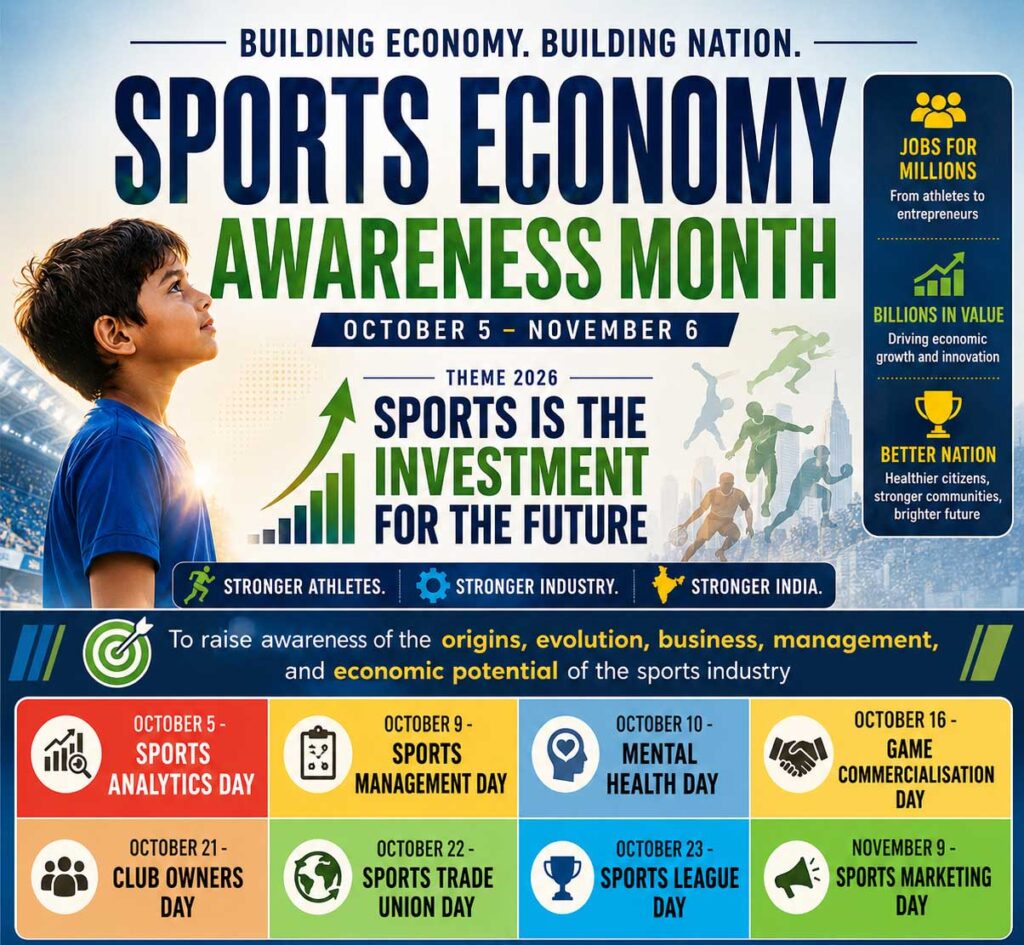
- October 5 — SPORTS ANALYTICS DAY
- Birthday of Henry Chadwick
- Henry Chadwick, widely regarded as the father of sports analytics, pioneered the systematic recording and analysis of baseball statistics. His work demonstrated how data could transform the understanding and management of sport.
- October 9 — SPORTS MANAGEMENT DAY
- Birthday of Walter O’Malley
- Walter O’Malley was behind the world’s first Sports Management programme.
- October 16 — GAME COMMERCIALIZATION DAY
- Birthday of Walter Clopton Wingfield
- Walter Clopton Wingfield was a pioneer in the development and popularisation of modern lawn tennis. His efforts to codify, package, promote, and commercialise the game demonstrated how sport could evolve into an organised and commercially viable product.
- October 21 — CLUB OWNERS’ DAY
- Birthday of James Gibson
- James Gibson played a crucial role in rescuing Manchester United during one of the club’s darkest periods. His intervention highlights the importance of responsible ownership, investment, and leadership in the survival and development of sports clubs.
- October 22 — SPORTS TRADE UNION DAY
- Formation of the Brotherhood of Professional Base Ball Players
- The formation of the Brotherhood of Professional Base Ball Players in 1885, widely recognised as the world’s first sports trade union. Together.
- October 23 — SPORTS LEAGUE DAY
- Birthday of William Hulbert
- William Hulbert was a co-founder of the National League, the world’s oldest continuously operating professional sports league. His contribution represents the emergence of structured professional leagues as the backbone of the modern sports industry.
- October 24- First whistle for GOAL 2066, India’s mission to win the football World Cup
- Birthday of Jules Rimet
- Jules Rimet, one of football’s most influential administrators, was instrumental in establishing the FIFA World Cup.
- November 6 — SPORTS MARKETING DAY
- Birthdays of Gabriel Hanot and Mark McCormack
- Gabriel Hanot was a visionary behind the concept that led to the European Cup, the predecessor of today’s UEFA Champions League, and was also associated with the creation of the Ballon d’Or. Mark McCormack founded IMG and revolutionised the commercialisation, representation, sponsorship, and marketing of sport, earning recognition as a father of modern sports business.
Why SEAM?
Sports is no longer merely a game. It is an ecosystem involving athletes, clubs, leagues, federations, fans, media, sponsorship, broadcasting, equipment, apparel, tourism, technology, education, infrastructure, events, and sports-related services.
The world’s leading sports economies were built by people who dared to imagine something different—and then acted on those ideas.
SEAM celebrates those changemakers, studies their contributions, and encourages a new generation to become the next builders of the sports economy.
Sports & Management Research Institute (SMRI) invites institutions, sports organisations, businesses, students, athletes, fans, policymakers, and entrepreneurs to use October 5 to November 6 to learn about the history of the sports industry, understand its economic potential, and explore opportunities to build stronger sports economies.